


Our team designed a speculative product for Google Labs (Olivia Sturman, Bri Doyle, Allen Bevans, Emily Levitt). Watch our product film here
I helped develop Wander’s initial end-to-end app flow, contributed to its high-fidelity UI/UX design, and directed the product film. I collaborated with Olivia Sturman, Bri Doyle, Allen Bevans, and Emily Levitt across the broader research, synthesis, and concept-development process.

Google Labs often works at the intersection of artists and AI tools, building products for them to harness the full power of Google’s frontier models.
But artists have a trust problem with the exact technology that is the most powerful in their hands.
Noticing this gap, Google Labs approached our team with a challenge prompt:
How might visual generative AI tools be reimagined to be more transparent, trustworthy, and educational for Gen Z/Alpha, while inspiring creativity rather than skepticism?
We started by talking to artists to understand their perspective better.
Research
How wide is the gap, and where does it start?
As a team, we conducted 30-minute interviews with 10 creators working across digital art, music, short-form video, and film to explore their creative routines, perceptions of AI, and what contributes to authenticity.
AI can’t create art the way a human could.
Nobody cares about watching computers play chess against each other even though they're better than us. People ultimately want to connect to humanity.
I would love to see some tool that does that also challenges someone's attention while promoting discoverability.
The attitude was quite varied. Some artists refused to incorporate AI into their process, while others thought it could make creativity more accessible. But there was a common belief that AI becomes problematic when it replaces the artist’s creative contribution. And this fear wasn’t just for artists’ own craft, but also out of a desire to protect the viewer’s perception.
After all, art isn’t just about the artist - it’s about the audience as well. That trust runs both ways - the artist must feel genuine about their work, and the audience must (hopefully) feel the same way. So we also looked into how Gen Z as a whole uses and perceives AI, to contextualize the broader context.
According to an OpenAI study, Gen Z are using AI primarily to ask questions.
- 49%Asking
- 40%Doing
- 10%Expressing
And while Gen Z seems to use AI more than any other generation, they seldom use it to make something - only 10% of use is expressive. So what’s keeping them from crossing into creation? We conducted our own street interviews around USC’s campus to find out.
It’s never gonna be as tear jerking as understanding and realizing that it was an actual person that produced that work.
We don’t want it to fully take over the creative process, but if it could help do the in-betweening work, maybe that would be okay.
It would play the role of giving ideas and starting conversations… it shouldn’t be the only thing you use. You should build off of that. … If you’re using AI and saying it’s your own — it depends how you’re promoting it.
You put a photo of you now and a photo of you as a kid… there’s something so nostalgic about that. That really does bring some soul into it.
Across 10 conversations, participants agreed that AI can create art. But the more difficult question was when humans and AI collaborate, and where the line is drawn between them.
Every participant saw a limit in a similar spot - AI at the beginning of the creative process (during ideation and development) was mostly considered useful. But AI at the end (the bulk of execution) made people start to doubt authorship and authenticity.
Gen Z is not necessarily anti-AI, but they weren’t on board with a creative process where human judgment, effort, and authorship became difficult to see. We turned this insight into 3 design principles:
Authentic
Both artists and the audience reject AI when the end result feels generic. AI work requires traceable human investment, and honesty about where inspiration came from.

Directed
The user is able to choose where AI enters their process, and retains judgement the entire way through.

Accessible
Most people interact with large language models by asking them questions, simply because nobody has shown them what else is possible or what the limitations are.
These principles became our north star:
“How might we design visual generative-AI tools that nurture creative agency and trust across a spectrum of Gen Z/Alpha attitudes in order to transform AI into a collaborative amplifier rather than a creative substitute?”
Exploration
With the principles and refined problem statement in mind, we came up with more than 50 concepts across 4 categories:

AI as a new medium of creativity
A digital product that simulates the physical wandering experience to inspire the creative process.
Use AI as search instead of a creator

Inspiring creativity rather than stunting it
Mad Libs input formats versus solely text or image
Showcasing interesting prompts and incentivizing people to prompt AI well

AI Education and Accessibility
Educational workshops for AI platforms in low-income communities
Program that partners with an educational brand (ex. Codepath)

Viewer and User Trust
A detection system that brings creativity and exploration back to the people
A watermarking system that embeds information in art metadata
The fourth territory, Viewer and User Trust, emerged from our interviewees. But we realized these concepts intervened after something had already been made - labelling AI-generated media or disclosing its sources, for example. These ideas responded directly to interviewee concerns, but they depended on the platforms themselves to adopt highly accurate standards. And more importantly, they did little to help a skeptical creator create something in the first place.
It ended up sitting downstream of the behavior the brief wanted us to address - helping Gen Z and Alpha feel comfortable creating with AI in the first place.
As we narrowed down our concepts, Wander emerged as the idea that could bring all 3 other categories together.
A digital product that simulates the physical wandering experience to inspire the creative process.
For many of us, the real world is the best source of inspiration. The random interactions between strangers on a crowded street. The light filtering through a window during sunset. The sounds and smells of a trail surrounded by nature. The quality and feeling of these often spontaneous moments simply can’t be found in a training set.
With Wander, instead of describing what you want and receiving a finished product, you describe what you're exploring and receive a set of directions - specific objects, textures, colors, sounds, moments to look for. Then you go out and collect them through photographs, videos, voice memos, and journal entries. From there, you can use AI tools to iterate and refine your inspiration, all in service of your final piece.
AI moves to the front of the process, where our participants are most comfortable with it, and the actual taste decisions, creative direction, and act of collecting inspiration never leave the artist’s helm.
Concept Development
We started with a rough 4-step loop:
- Tell Wander what you’re creating or exploring.
- Receive directional prompts for exploring your surroundings.
- Add an image inspired by one of those prompts.
- Generate variations, save what you like, and continue wandering.

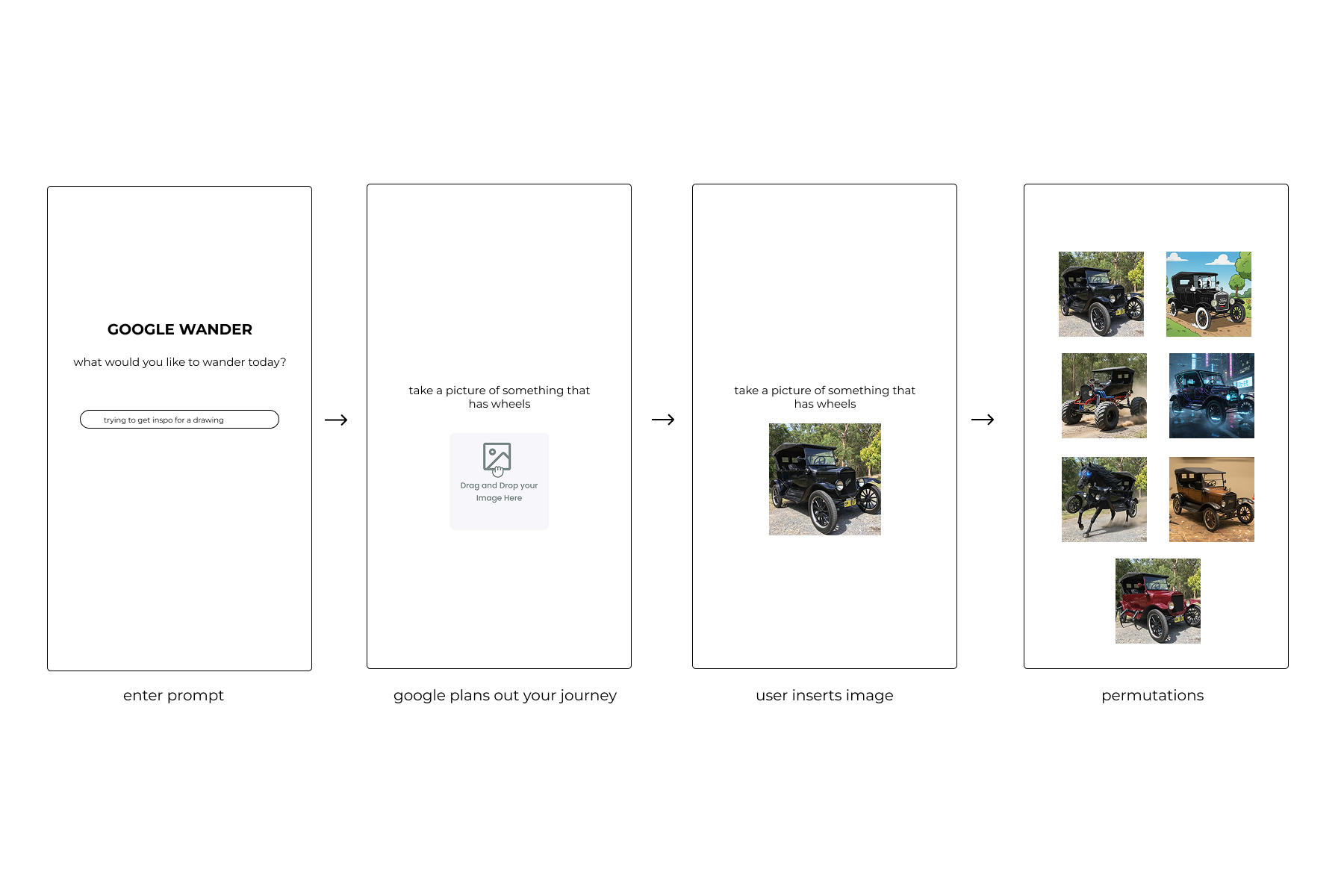
This direction was largely positioning Wander as a generation interface. But this was already a well-explored area, and wouldn’t advance our goal of keeping human experience at the center of the creative process.
The more valuable opportunity for us was focusing on the moment of capture.
According to our artists, capturing inspiration often happens through many different mediums - quick photos, a song or a sound. Normally, capturing these requires you to switch between a few different tools while the moment is already passing.
This changed Wander from a generation-focused product to a launchpad:
- Tell Wander what you’re creating or exploring.
- Receive directional prompts for exploring your surroundings.
- Capture the images, thoughts, and sounds you encounter.
- Export it to Google’s creative AI tools to remix and refine.
And if Wandering was the heart of the app’s experience, capture needed to be the fastest and most frictionless part of the product.

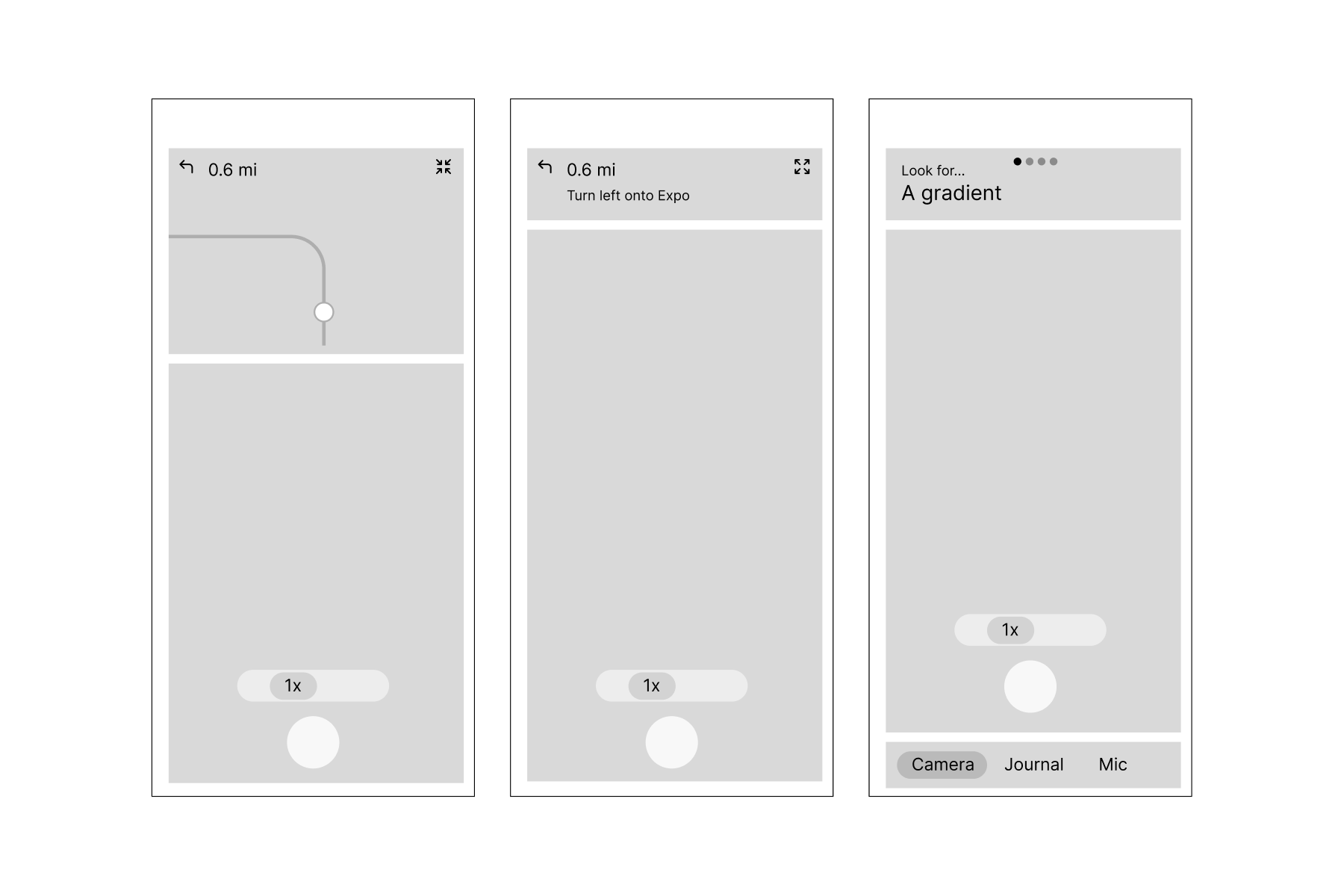
During a Wander, the interface should require as little attention as possible. The user should focus on their surroundings, not on the app.
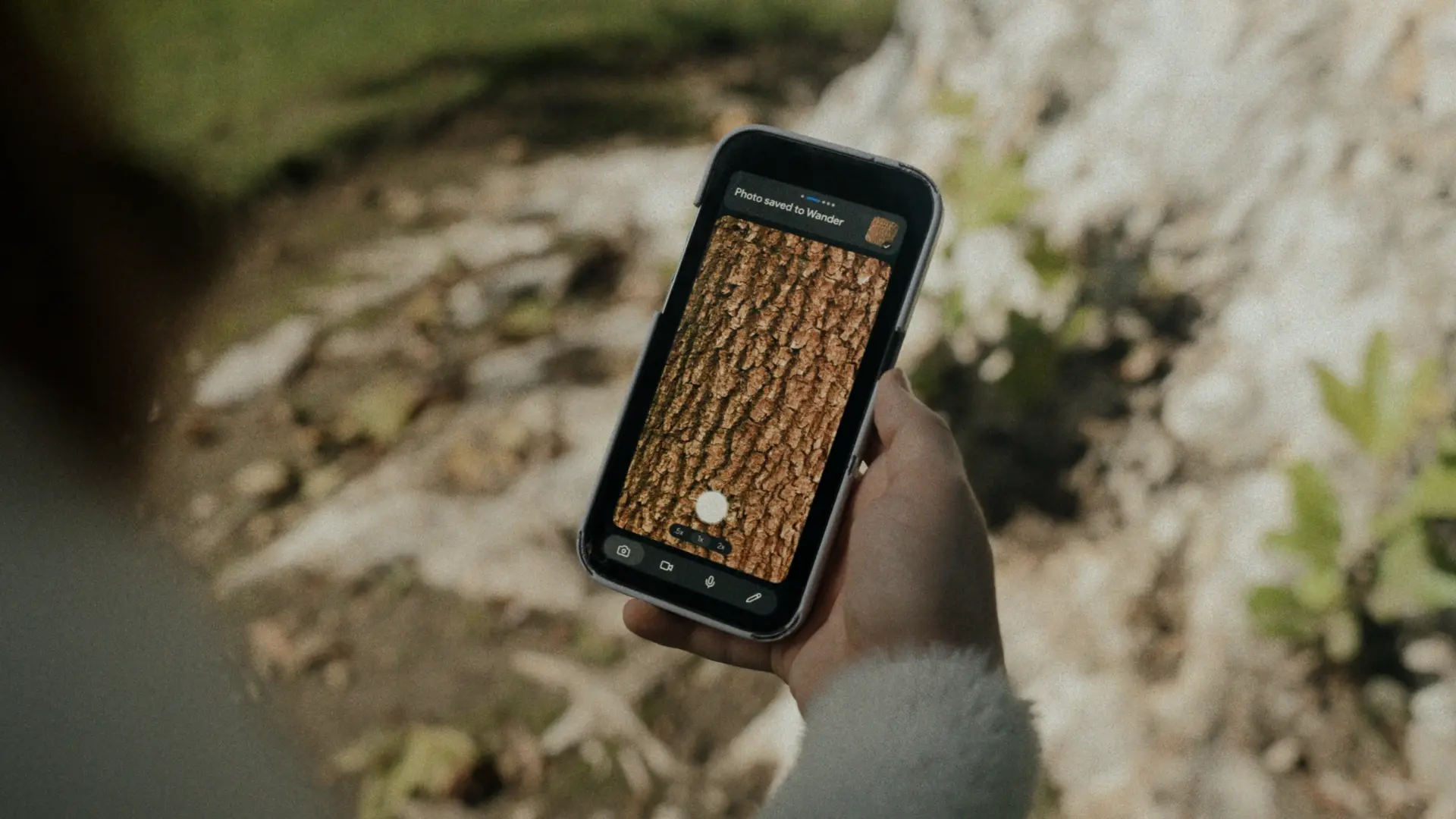
A small area at the top of the screen lets the user cycle through Wander’s directional prompts. The rest of the interface is reserved for capture, with a distraction-free camera open by default.
A bottom tool switcher lets the user switch between four modes - still photography, video, written notes, and voice memos.
It provides enough feedback to let the user know that a moment was saved, then gets out of the way. The goal is for Wander to feel like an extension of the user’s attention, rather than a standalone tool.
Only after the Wander ends does the app let the user revisit, organize, and remix what’s been gathered.
Final Product

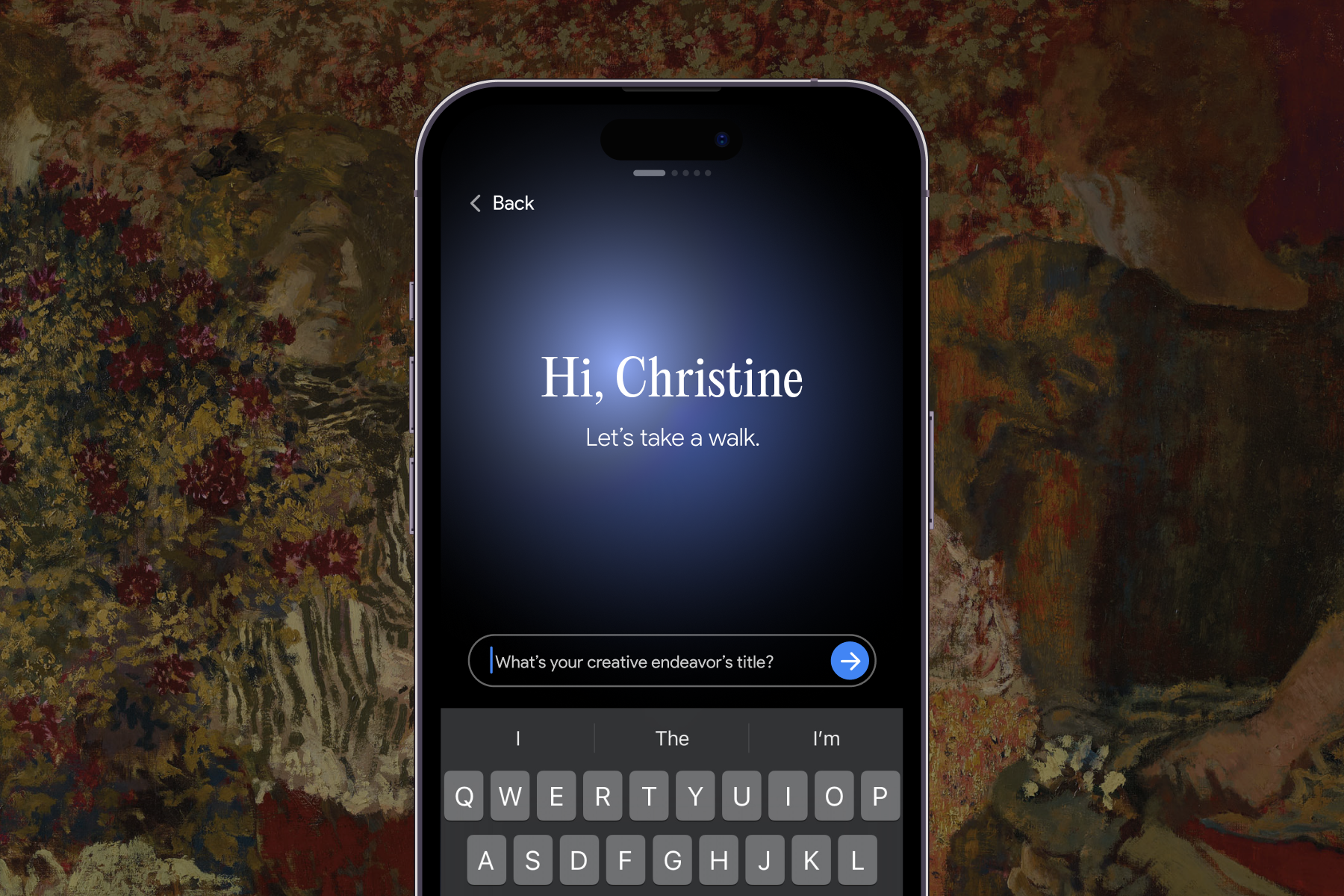
- Name what you're working on
Wander uses only two open-ended text inputs throughout the app. The first asks what the user is making/exploring.
This functions as both the title of the project, and also a guide for our AI to come up with relevant directions. A user who types "flower dress" has told us plenty, without needing to know how to construct a detailed prompt.

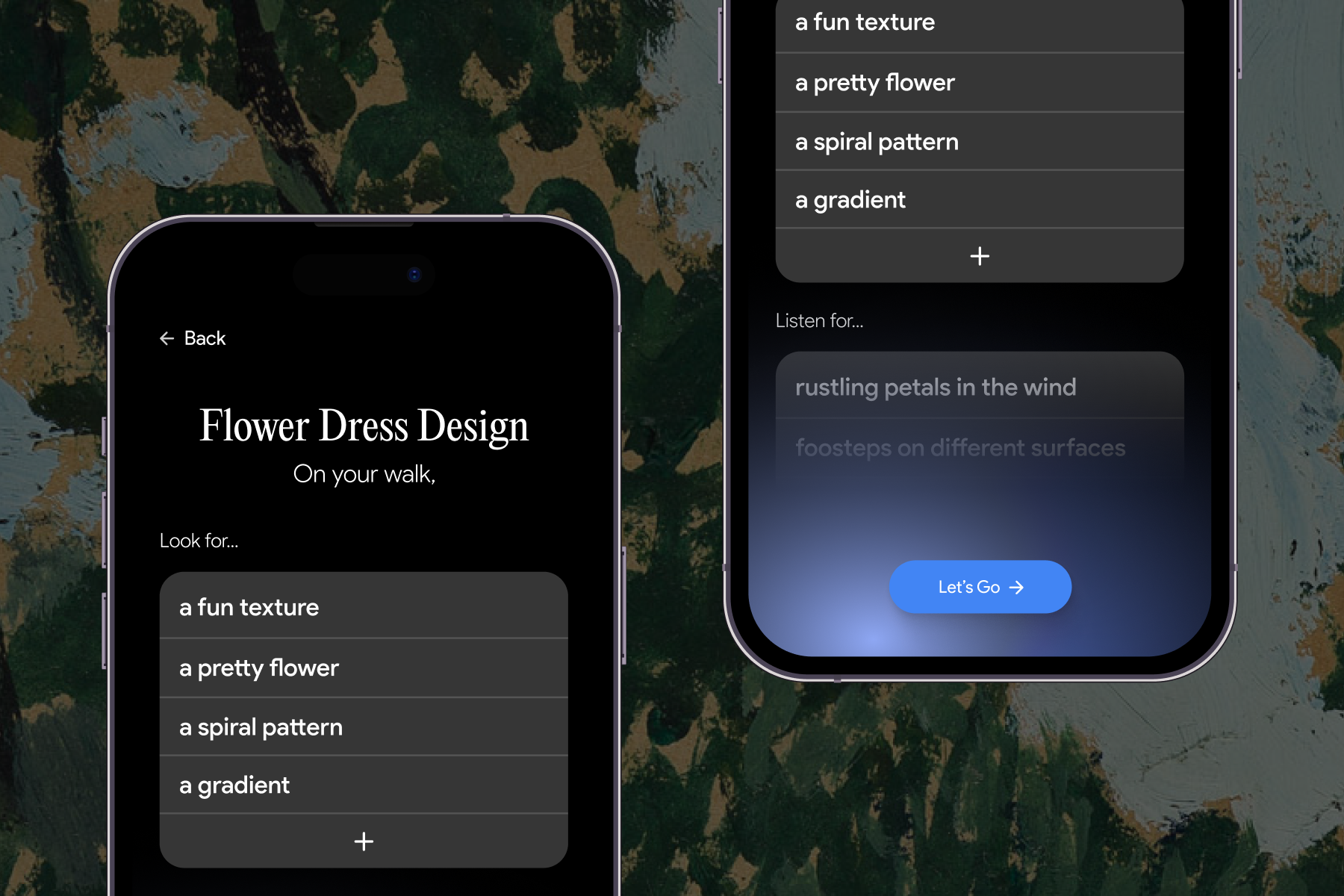
- Wander provides directional prompts
Wander returns a handful of things to look for in the real world - objects, textures, colors, sounds, moments.
We kept these deliberately open-ended so that they’re both accessible to everyone and also promote your own creative mind and eye.
It would be unreasonable to prompt our users for a photo of a blooming flower if they’re living in a desert, for example.
More importantly, a prompt that’s too specific can shift the user’s mindset into something other than what we want to promote. Instead of users asking ‘does this count?’ we want them to ask ‘does this serve what I'm making?’
Open prompts leave room for the user’s interpretation, so the creative judgement is always in the hands of the artist.

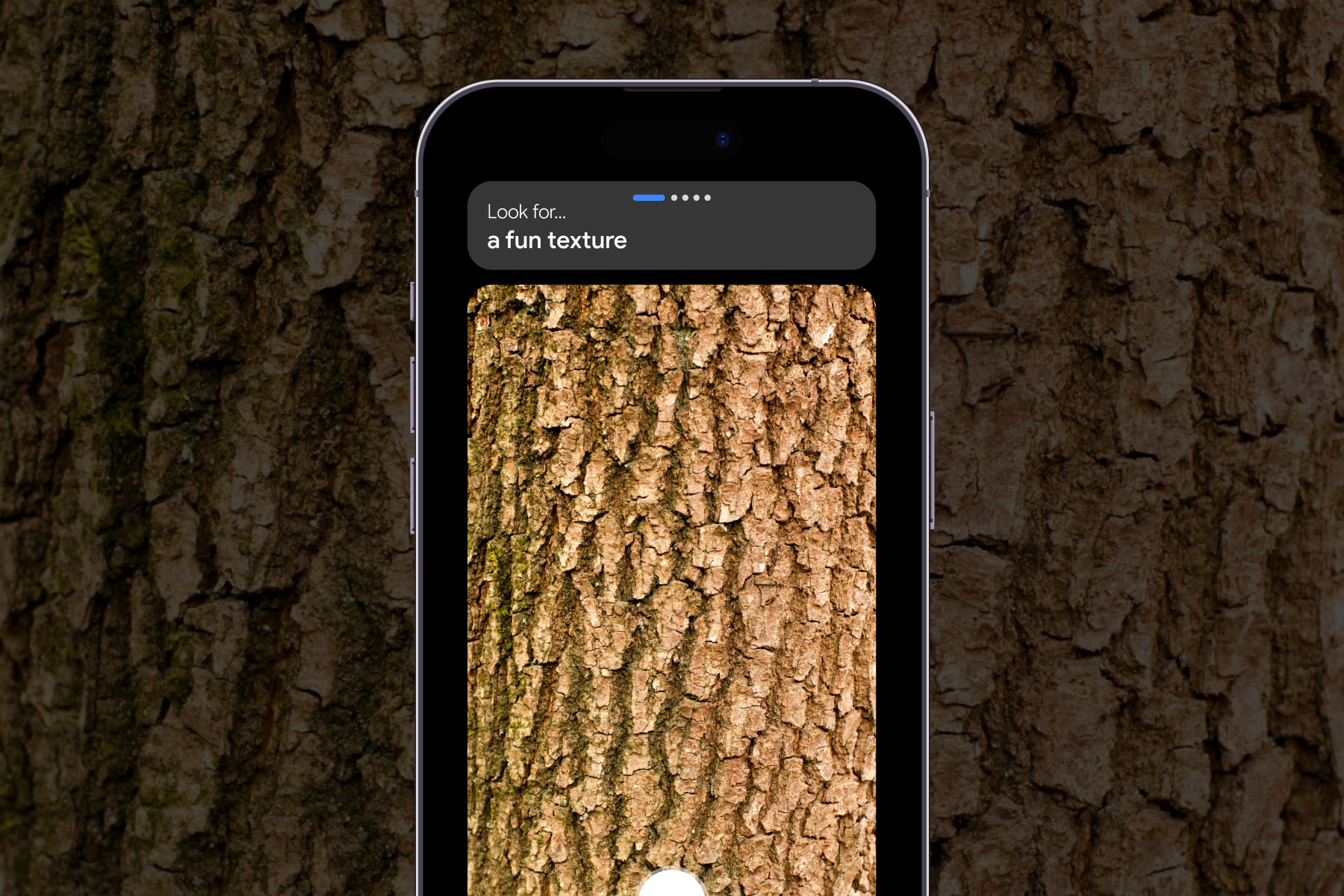
- Wander
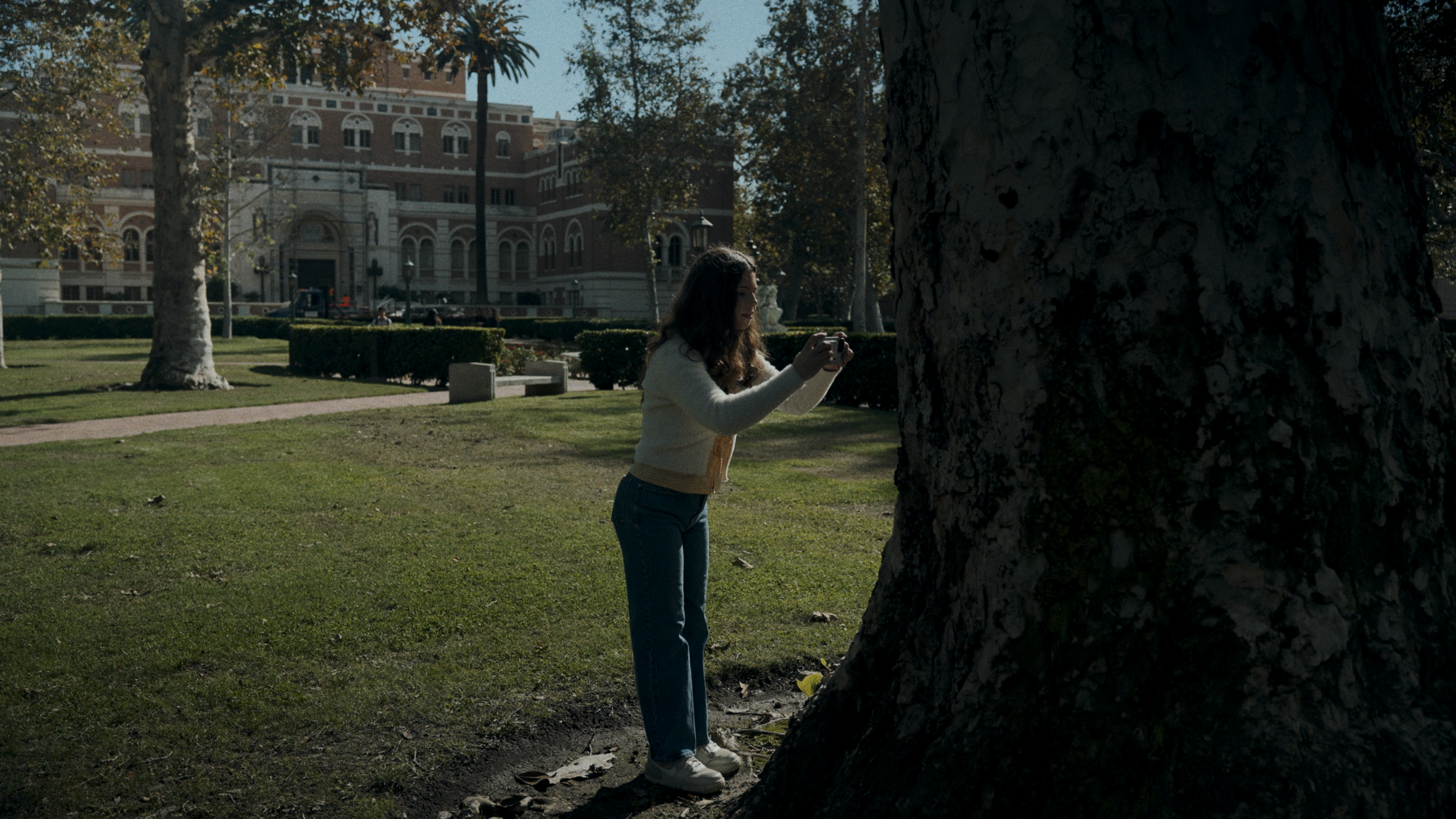
Go outside, touch grass! Wander becomes a camera, a microphone, and a notepad.
Some of the best moments while inspiration hunting only last for a second, so capture has to be the fastest thing in the app. The interface only surfaces the tools you need.
And because inspiration can often come from the unlikeliest and most serendipitous of places, the prompts are just a suggestion - nothing you capture has to be attached to them.

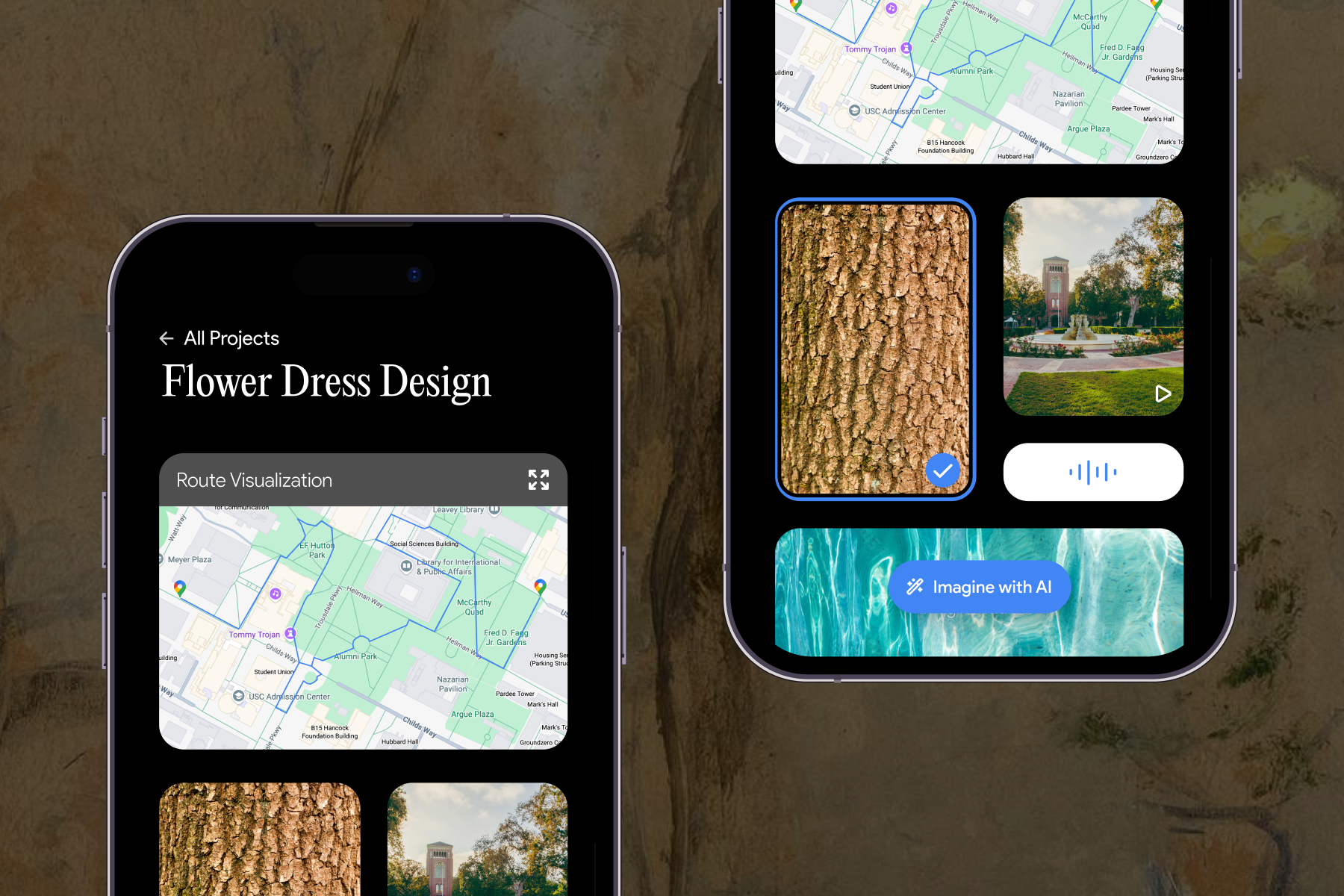
- Revisit, organize and remix
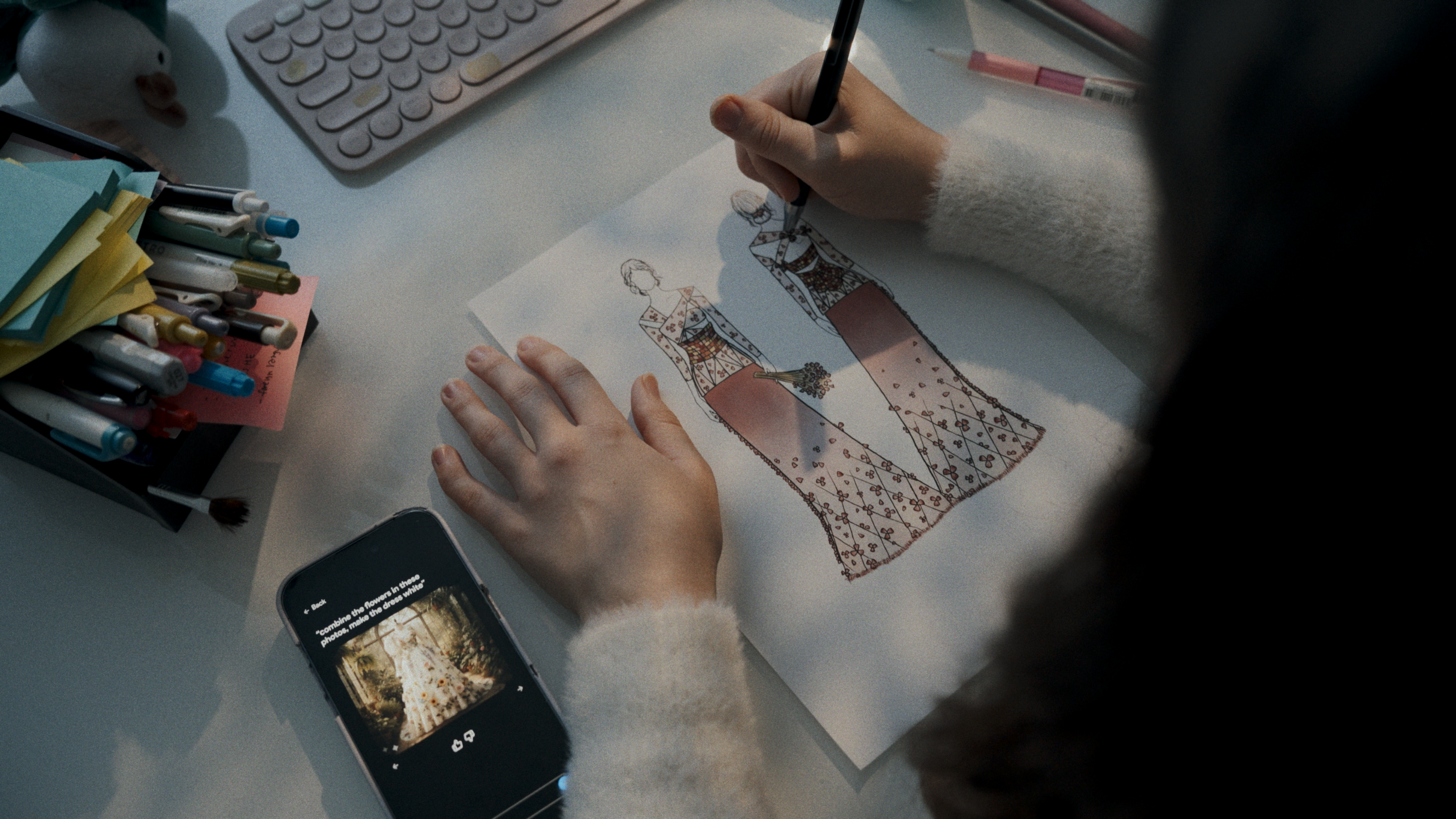
Once you’re done wandering, all your photos, recordings, notes, and voice memos save to one place. From there, you can export to the rest of Google's AI suite to remix them.
This is the second and last blank textbox, and by now you're describing what to do with material you gathered yourself.
The consent/credit question that came up in our interviews:
They should credit every piece of art that they use to train.
is less relevant when the source material is always your own. It’s a natural consequence of putting AI at the front of the creative process instead of the end.
Video
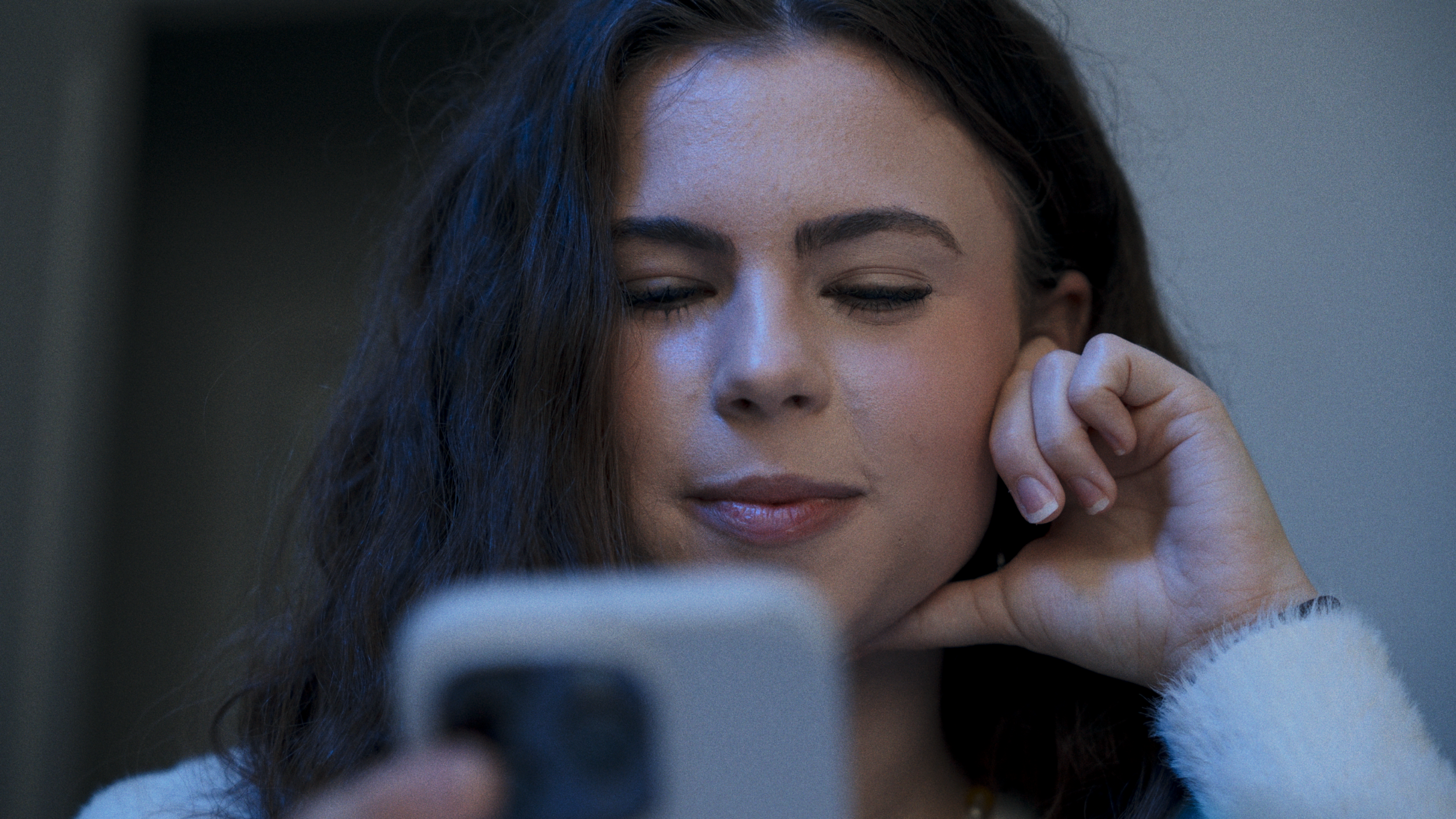
To show what this feels like in action, I directed a product film. Watch it here

Next: How We'd Validate
Our North Star asked whether AI could become a collaborative amplifier rather than a creative substitute.
Because Wander was designed as a concept, we never got to validate our assumptions in front of actual users. These are the most important ones:
People will actually go outside.
The product requires that artists are willing (and able) to go out on an inspiration walk.
Open-ended prompts work everywhere.
Our research leads us to believe that artists want AI as a starting point that is built upon. Open-ended prompts are how we believe AI could function as that starting point while still being accessible to everyone. But this is still a hypothesis.
Collected material actually gets used and remixed.
Capturing stuff is easy. But retrieval is something totally different. We’d want to know if users actually revisit what they capture, or find the process valuable in the first place.
And back to our original idea categories, we could investigate whether Wander addresses the mixed artist sentiment that we found in our interviews:
Gen Z reaches for AI constantly but almost never uses it to make things. Does going outside first change that?
Do users leave with a better understanding of what AI tools can do, and how to use them?
If you posted the work, would you say that AI was involved?
How could we test our assumptions? It’s easy and fun!
We would become Wander for 8-10 people. Half would be artists with a project already underway. Half would be Gen Z who use AI constantly to ask things, but almost never to make things.
Each week, we’d text everyone a small set of directional prompts based on their work, and ask them to go out sometime that week and send back whatever they find. We’d ask them to run some of it through Whisk or ImageFX and send that back, too. We’d be able to see how many people actually went out to wander, what they came back with, and how they interpreted the prompts. We could follow up later and ask whether any of it made it into the end result.
For the non-artists, the reflection is much more interesting - we’d be able to see if Wander encouraged them to make anything at all, and whether they would go out again.
There are some limitations to this MVP version of Wander. Firstly, both groups would be people we know. They’d be much more likely to try wandering simply because a friend asked.
Reflection
Most of our trust and media labelling concepts were mine. They were some of the most prominent points we heard in our interviews, and I spent the most time exploring the problem space.
But when we tried to flesh out these ideas, every version required the platforms that host the media to change. Labels only work if they’re extremely accurate and widespread. And we realized we had found a systemic issue, one that the scope of this problem wasn't really fit to handle.
The best we could create, end to end, was a tool that encouraged Gen Z/Alpha to create more and use AI ethically, the way they want to - something that is actually positioned upstream of the platform problem.
At the end of the day, human creativity always wins. It has never been bound to a single medium, and technology has always bent toward it rather than the other way around.
That instinct predates any tool or piece of technology we’ve ever built, and I think Wander is a bet that it’ll stay this way; that these tools won’t become replacements, but rather the means for us to find new, inventive, unprecedented ways to actualize ourselves.